Rome
Day 1
We started the day a bit late, some days it's just hard to get out of the tent. We made coffee and "fruitcake pancakes" again, this time with eggs…they still were awful. Luckily the package is empty now.
After futzing about for what seemed like hours, we headed out to catch the shuttle bus to vatican city. After a quick word of advise from our tenting neighbours, we paid 4€ each for a day pass on the transit system, grabbed the bus, then the underground and finally legged it for Saint Peter's Basilica.
Well now, this was interesting. In all the places we've been thus far, I've never experienced the pushy sales tactics employed by the tour guides here. After saying no to about a dozen "guides" just on the walk to St. Peter's, we were finally suckered in by a british guy. Oh well, we were walked over to hear the companies guide talk about what we'd see on the tour. The girl leading the tour was pleasant and seemed to know here stuff, so we went along with it. The price wasn't too bad either.
We started by leaving the square and headed around the corner to wait in a line. Eventually the line leads to the entrance into the vatican museum. JEBUS, you could visit this place all day for a month and not see it all. There is something silly like 7 MILES of galleries in this place and it's extremely easy to get lost in. We proved this after the tour ended in the sistine chapel and tried our way back. More on that later though.
Back to the tour. After entering into the building, getting our audio gear and heading up to a courtyard, we entered into the building and proceeded to browse through the map room, the hall where Raphael's tapestries hang, Nero's bath (why is this here?), and many more nooks and crannies full of marble statues. What a place, everything, and I mean everything is either gilded with gold or painted. It seemed like every inch of any ceiling was covered in frescoes depicting one scene or another from the Bible.
Finally we were herded into the Sistine Chapel. I stealthy snuck my camera into my pocket and started video taping (very Bond, I know). Much to my amusement, as the guards dealt with the other tourists with a chorus of "NO FOTO!" and "SHHHH" followed by clapping. I happily looked around, awkwardly leaning so the camera would see the paintings. On the subject of the paintings, our guide was quite knowledgeable, she was able to jog my memory of things I apparently already knew. Funniest of which is the pants painted on Gods bottom after Michelangelo died. I guess something remains of the 4 years of art classes in high school. I'm still not sure on the paintings - yes they're nice, but I think it's overhyped. Too noisy, too busy, and a bit like the stained glass found in the cathedrals over here. You need something to see the distant parts with any detail.
After we said goodbye to our tourguide, we headed for St. Peters Cathedral (Basilica!!! says Liz). Asking guards along the way how to get there, we were forced to exit the museum, down a really neat double helix staircase and ended back out on the street. Making the best of the situation we headed back to the square and hopped as much of the que as we could. A few minutres later we were funneled into the crypt below the church (where Pope JP2 was "housed", he has since been exhumed to fulfil a beatification ritual...). It was filled with wacky people gawking and wailing, we rushed through the Empire-like area (btw Benny the 16th really does look like Palpatine) and up into the church. Our luck being what it is, it was time for evening mass and the more interesting things in the chuch were sealed off. So after a short visit we left and headed to the Vatican Post office to send some postcards home (apparently the Rome postal service is sh*t and it's advised to use the more expensive and reliable Vatican service).
It was getting late in the day and we were hungry, so we hunted down a small place, had a slice of pizza and headed down the street out of St. Peter's. Being just before Easter, there were statues displayed along the boulavard depicting Jesus's death... remind me again why it's called good friday? I'd be having a very bad day if that was me. Anyway, we walked down to the river, crossed, found a wine bar and enjoyed a bottle while the sun dipped to the horizon.
We arrived back at the campsite to find a family of French people and thier giant Tacoma camper truck parked next to us...Damn. Early the next morning (around 6am) the father would start up this monstrosity and let it idle for 20minutes. Who does that?
Day 2
After being woken early by the aforementioned neighbour, we headed into the city again. Direction forum. Still not having mastered the public transit system, we got off at the wrong stop on the bus and had to walk a bit to the metro. Eventually finding it, we exited near the forum. Feeling peckish we walked towards neo-classical "typewriter" building and found a place for a coffee and a bite to eat. That over with, we started to explore the ruins of the forum. Luckily for us, it was Rome week and all the public attractions were free! The free part being great for us...and everybody else.
It was busy. The forum and the area around it is massive. We spent hours walking through the ruins on either side of the road that lead to the coliseum. Liz being the fantastic and knowledgable tourguide she is, walked me through the entire site and was able to tell me interesting things about most of the area. What surprised me was the use of brick and cement (SERIOUSLY HOW DID WE FORGET HOW TO MAKE THE STUFF!!!) When you see the exposed inner walls of the buildings, it's no wonder that many of these are still standing today. Anyway, the forum is vast; so vastly vast that if you were to stand at one end and see a sign that says "you are here", it would literally blow your mind. So instead of describing it, I'll refer you to wiki. Go there now....and then come back, we need your viewership to pay the bills.
After a few hours, we decided to head down to the coliseum. It was besieged by preteens and their keepers, so we opted to sit and have lunch and look at it instead (we've seen quite a few of the arenas in our travels and decided it would be ok to give the insides of this one a miss). What a silly idea to sit and eat near there, overpriced and under ripe. Oh well, we live and learn. After a nice break we headed back into the forum, to see the upper parts that we had missed. Again, struck speechless with the scale of the place, it still hits me now just trying to describe it, so I won't. Go read wiki. And wait for the pictures.
Having seen the forum and the surrounding areas, we legged it for the city itself. On the agenda was the pantheon, Trevi fountain, and the spanish steps. Now, i think that we've been a little spoiled with our adventure so far. Most attractions we've seen have been empty or nearly empty of tourists at the time we've been there. Not these three; preteens, handlers, hawkers and the all too common fat slack jawed tourist with some part of skin hanging out that shouldn't be. At the pantheon (btw, i'm ridiculously annoyed that it's a church inside) there was hardly room to move around the street, we entered, saw that it was a church, took a look around and left. The spanish steps are well, steps, for climbing they serve there purpose well. I'm not sure the attraction to them by tourists. OK I get that they are a huge set of steps, and the sun hits them nicely for sunbathing, other than that, I mean the view from above them is much nicer. Any way, fed up with the tourists we moved on and wandered to the Trevi Fountain. Along the way we passed a million obelisks, some left in there original state, some placed with crosses on top by the church (kind of a conflict of religions going on there).The Trevi Fountain is astonishing, even through the sea of tourists that crowd the area, it slaps you in the face with it's baroque design. All the rage when the fountain was commissioned. It was built between 1732 and 1762, with the original architect dieing half way through construction. The backdrop for the fountain is the neo classical Palazzo Poli, it was given it's facade specifically for the fountain, after it ha the central portion demolished to make way for it. Nice.
We finished the day with a walk through the shopping district in search of some summer wear, shorts and t-shirts in hand we headed back to the campsite for the night.
Day 3
We spent day 3 like day 2, wondering around the ruins of old rome and then exploring the cities small streets. Our first stop this time was the baths, another huge complex, unfortunately for us, much of it was fenced off, owing to restoration work and threat of collapse The sections we were able to get into were constructed of brick and concrete, and mostly still intact. Although the roofs had cave in, in some. Being spring, the grounds were bright green and the smell of oranges ripening was in the air. The area was littered with fruit trees and signs saying do not pick the fruit.
After the baths area, we headed in search of a small bag to use as a day carry bag, this led us to an amazing outdoor market. It was a covered, endless maze of hawkers and real vendors selling anything from used clothing to rip-off sunglasses and bags (the best quality ripoffs to boot!). After browsing every stall in the market, with liz getting annoyed at my indecision, I found a small army surplus unit...little did i know it's th exact same bag i have at home.
The bag job done, we finished the day off with a walk up the spanish steps as the sun set. As we came down we found a Leonardo da Vinci exhibition and couldn't pass it up. It was a neat place, full of models of Leonardo's creations that the public could tinker with. It was fun, like being at the science center on a smaller scale.
The day over, we grabbed some food and headed back to camp. Rome had been fun, but it was time to move on.
Monday, June 27, 2011


Thursday, June 16, 2011
Hi-ho here comes Rome
Don't ride along the Via Aurelia here. The map and all signs say that bikes are allowed; they shouldnt be. We did see groups of roadies, who clearly had no standards. Find a better road, one that is not populated by 120km/hr cars.
One of the roadies, an old guy who was either leading or trailing behind a pack of other riders gave us warning of the route ahead. "Quatro duro!" he yelled at us a few times, waving his arm to indicate the road ahead. There were other Italian words in there, but none recognizable to me. I fibbed a bit to Matt, saying that there was only one hard bit ahead. Of course, the message was about the four hard climbs to Rome. But why bring the mood down?
After hill #3, my tire she blew. That meant removal of panniers, bag, rack, skirt guard, fender, wheel, tire, tube. Not all of those items made it back onto the bike. After fussing with the tire change for two hours, we finished riding the last 5 kms to the campsite. Spent the remainder reading and sunning.
Saturday, May 28, 2011
Hobo venture: Tarquinia Turtles

We discovered a bit of an ant problem in the BnB. Stupidly, we had left open the food bag, and even though all was encased in plastic bags, the ants ferociously inhabited the pannier. A quick swipe and dump seemed to get rid of them all.
Saying goodbye to the BnBs garden turtles (so old and cute!), we hauled our asses up the hill, out of medieval Tarquinia to the Etruscan necropolis of the ancient and destroyed city. I questioned my feeling of deja vue, but didn't think that I could have forgotten an entire city in the span of five years. Later on, asking Dad, I was informed I had forgotten my first visit with family.
The place Matt and I were at now was a huge necropolis site, used from the fifth century BC to the second century CE. Similar to some of the necropolis in Populonia, these graves were set deeply underground in man made chambers. The Tarquinian Etruscans, and later Roman inhabitants, carved beds and pillows for the dead; but also created a space reminiscent of the rooms of the living. The ceilings was peaked and decorated with colourful and intricate patterns. The walls were painted with scenes of the daily lives. For the hunting man, painted sacrificial animals were chased about by the scantily clad. The rich dame was given a feast with nubile dancers and exaggerated pugilists. The chambers became family crypts, with the old and the young and the in betweens placed together... Forever... What A Nightmare!
The necropolis stretches over hectares of land, of which only a small percentage is open to the public. Of the opened tombs, some were undergoing restoration and were also closed. That's the way it is though. Ancient artefacts need care and attention. And that attention must be done by trusted professionals in a controlled and uninterrupted environment. I get it. I don't like it, but I get it.

Of course, we're still finding bloody ants in the cookware occasionally. And there's a large amount of food bag paranoia.
Leaving the tomb site gave us the opportunity to rush madly along the steep hills of modern Tarquinia, which is actually a medieval town by the name of Corneto. The city was renamed in an attempt to bolster Italian heritage pride. Unlike the attempt in Populonia in the middle ages, this was done in 1922 CE. A slightly ridiculous move by the Fascist government. We got to the coast and followed it by zona militare. Signs outside threatened to snipe trespassers. We finally reached a more hospitable area of kiddy parks and fairgrounds. Once reaching the city, we picked a campsite address from an Italian iPhone app. The address given ended up being a single parking spot for a camper van. At the next attempt, the campground was only for camper vehicles.
We said a big "pppffllltttt" to camping, and got a nice and cheap hotel. We are the worst campers ever.
Saturday, May 21, 2011
Hoboventure: Go Go Grosseto.
Grosseto ended up being a poor decision. There was no way back to the coast, and the only road out went up. Tuscany was wrecking her rewenge! for us ignoring her inner landscape. At the first easy hill - barely an incline from the horizontal - I was done. I had a bit of a moment of hating the bike and the road and the heat and the everything. Maybe because it was noon, and the land here is parched. The midday Tuscan sun drains energy. Riding felt the same as when trying walk with a child attached to your legs. After a quick break, which let me straighten my very bent rear wheel, we continued up. There were hilltop towns, olive groves, sheep filled fields and walled cities. At the walls of Magliano in Toscano, our path turned downwards, nearly back to the coast. We ended in Albinia (not Albania!), which is an entry point to this weird outcrop of land called Orbetello. It's weird because it's basically an island, except it has three perfectly oriented land bridges. The thinking was that we could get from Albinia down the coast to a place two days' ride from Rome.
Nope. The only road we could take was the one we'd been on. And we'd have to backtrack 15 kilometres uphill, with another three days of hills to follow. Every other road out of this twee town was a highway.
Fine, crazy Italian road planners! You won! We took a train to Tarquinia. Found a cheap and excellent B&B for the same price as a campsite. Hot water? Comfy bed? Balcony? Yes, please!
Saturday, May 14, 2011
Hoboventure: Etruscan Exploration
Amazing.
Our arrival was perfectly timed. We were just at the gates of the archaeological park at it opened, with no one to keep us company. The archeopark covers a part of a hilltop town of the Etruscans, called Fufluna. The town was inhabited between 1200 BC (Italian Bronze Age) and 570 CE. Life was based on the economy of fishing, metal smelting and trade. By the appropriate intellectuals (i.e. Etruscologists), it was once the preeminent town of the region. Its domain stretched from the occupied hilltop to the islands of Corsica and Elba and inland to the lost Lake Rimigliano. It was truly a strong city of the Etruscan peoples.
But the rise of the Romans nearly wiped it out entirely. There were changes in the architecture, as can be seen by the large public areas (baths, temples and plumbing), as well as the construction of a typically Roman road. The housing of individuals changed more slowly. However, it recovered partly. To be used as a mainly metal smelting industrial town. Elba provided iron oxide, and the surrounding hills of Populonia (now called by the Romans) provided the wonder materials of copper, lead, zinc, tin, iron and silver. That means that the town could produce bronze and steel, as well as the luxury of silver.
Populonia was abandoned by its population in 570 CE. This was partly due to the change in environment around them: the inland lake became silted as farming increased - which means there was a loss in the local food supply of shellfish and an increase in malaria; and the sourcing of metal changed in quality and ease of access. Also, it was sacked by the barbarian northern Lombard tribe. The population had been decreasing over the centuries anyway. People gradually figured out that lugging themselves up and down a bloody hill was stupid.
Apparently though, we were stupid enough to have attempted it that morning - with the bikes and all our kit. Matt didn't want to leave our stuff locked up at the side of the deserted road (danger from squirrel gnawing?) so we walked everything up. There was no way we could have ridden - maybe with better bikes. The downhill return was excellent fun. We did find out that hairpin turns on steep descents require braking forces. And braking for an extended period of time with a heavy load means we pooched our hubs for a while. The rear hubs are coaster brakes, and work by expanding an internal ring against the hub, causing enough friction to slow the bike down. The grease inside heats up, becoming less viscous, and oozes out the (poorly sealed) hub. Heat expands everything, making it harder to pedal once done with the gravity-aided motion. We gave our bikes an hour's rest while visiting the necropolis.
The Etruscans had put a lot of effort into their burial rituals. Set into a nearby hillside, the journey from the city of the living to the city of the dead was a 6 kilometres walk through dense forest and uneven terrain. The graves were embedded into the rock of the hill: steep tunnels were carved downwards, with steps and an entranceway. Within a small rectangular chamber were one to three beds carved out. Some even had small stone pillows for resting one's head. Once finished, the entrance was sealed with a single block of stone, and the passage way was filled in. The tombs were set side by side, with the tree canopy over head or a rock overhang. The largest series of tombs were placed in a vertical rock face in a large open space. The rock face wasn't natural, but had been carved out over time by the quarrying of the hill for raw materials. Grave chambers were set at intervals all the way up the 50' cliff. I quite felt like shoving all of the visiting school children in one and sealing it again. Matt says one was going to throw rocks at him. I'd let that one live.
Obviously, we started riding late in the day, at about 1330h. The route took us away from the coast, cutting across a peninsula and cutting out some kilometres. Of course, as soon as one goes inland in Italy, one hits an elevation change. The Apennine Mountains run down the italian boot, and their foothills spread from shore to shore. Eventually, the gradual incline turned into an actual hill. Zut! That was tough. Right at the crest, we were passed by a pair of mountain bikers (it's big here, 'cause the terrain is excellent for singletrack). Very soon after, our lumbering selves caught them up. Matt was about to pass them when I called him off. Partly because I had no way to go faster and partly because I had gotten myself into a high-speed tank slapper. The entire rear end of my bike had started swaying violently and there was no way to stop it. Terrifying.
The view at the valley was of more hills, luckily less extreme than the first. Slowly, we wound our way to Grossetto. The last few kilometres were a smooth bike lane. It's always nice to end a long day with an easy section. Especially when the bikes and the legs are both pooched.
Tuesday, May 10, 2011
Hoboventure: Al Tende
So the great and glorious campsite taught us a few things: Don't set up near lampposts or the loo. The nice spots are packed and pricey. Bring your own toilet paper. And it's really awkward to shower in a dark midget closet.
We headed out onto the road, which was somewhat "mountainous", but all coastal. It was also the first time we made it onto the Via Aurelia on our bikes. The same Via Aurelia that we'd seen in southern France in December. Since Pisa, the Via Aurelia had been a major highway. But from here on, we would follow it all the way to Rome. I was excited, as one of my old Latin textbooks was about a family's journey along this road to Rome. It was like my own personal pilgrimage.
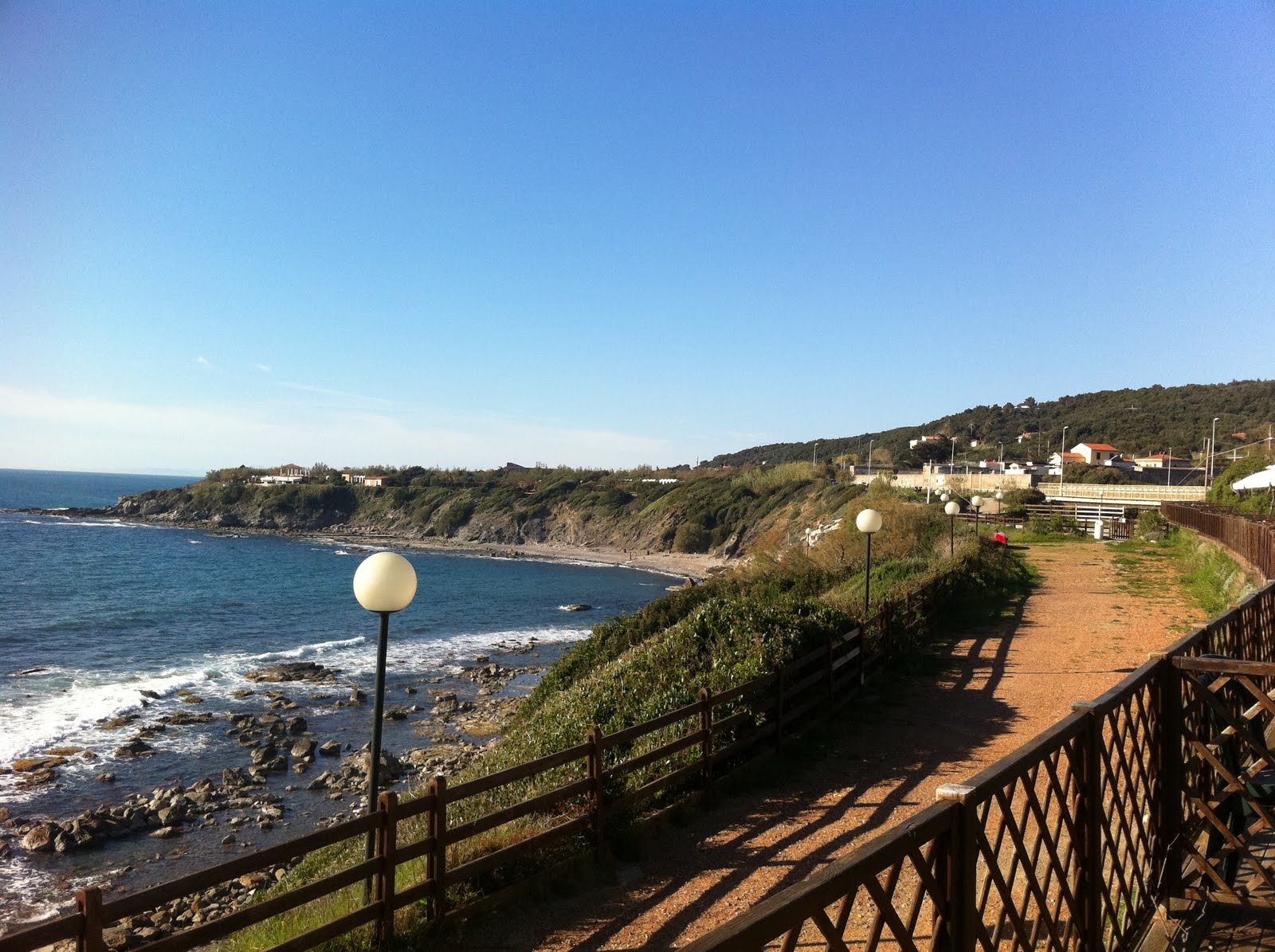
The coastal region of Italy is not easily accessible. First of all, the geography ranges from near idyllic sandy beaches to steep rocky sides. Where the coast is nice, it is privately owned. Some of the small close properties have been turned into cafes, with advertised stabilimento balneare. To the best of my understanding, it means a built-up beachfront. Of course, one has to buy something first. There are national parks, with occasional pathways to the water, but it's rare. Along the Via Aurelia, we passed by cliffed plateaus with sunbathers, pine forested dunes and seaside agricultural fields.
Having ridden to the Populonia turn off, we didn't see a nearby campsite. There were signs to a few beyond, but none close enough to really consider. We pedalled back about 2 km to one that had been flying a variety of flags - only to find that it was closed until May 1st (first we had to ride along a crappy road for another 2 clicks to gather this information). We then passed by an agritourism (with camping) that looked like a shanty village. Near Populonia, we turned along a road to find the advertised campsites. Except what we found was a reception in a sinking trailer with no sign of human habitation. We decided to camp in a parking lot.
There was a bunch of fuss over spot selection. Do we set up in the shadows? Near the disused building or away? By that road or another? It's worse than selecting a house! Eventually, the annoying biting bugs forced our hand to just plop it down here-ish and park our bikes there-ish. We also came up with the great excuse of "It was late, we couldn't find a campsite, and we're stupid tourists". Sometimes the truth is the best.
There was a bunch of fuss over spot selection. Do we set up in the shadows? Near the disused building or away? By that road or another? It's worse than selecting a house! Eventually, the annoying biting bugs forced our hand to just plop it down here-ish and park our bikes there-ish. We also came up with the great excuse of "It was late, we couldn't find a campsite, and we're stupid tourists". Sometimes the truth is the best.
After set up, we behaved like squirrels - freezing our movements at any sign of near movement. At one point during dinner, an SUV drove right up to the tent, pulled a u-turn, paused, then left. Really weird. Finally, we gave up caring and just went to sleep - the thrum of vehicles our lullaby.
Our wake up call was the garbage truck dumping glass bottles into its maw. Nice.
Our wake up call was the garbage truck dumping glass bottles into its maw. Nice.
Saturday, May 7, 2011
Hoboventure: Antignano Aunt


Our intention for the day to was stop somewhere between the Livorno and the Marina di Bibbona. We left Pisa and our campsite at about 2 PM heading straight for the coast along the Arno again. Even with the headwind, riding was pretty easy. The smell of salty ocean and the increasing number of marinas told us we were near. The road then turned southward: teasing glimpses of the sea over farmers fields were all we got. Thankfully, the road meandered closer and closer, until we were riding along a beach front boardwalk in Tirrenia. Stopped in the heat for a fro-yo. Whose health benefits were negated by the strawberry and lichee sauce. Eventually, the quiet biking got much busier. Cars were more prevalent and it became difficult to weave through. There was a bike path, which was glorious for the first while. But we'd hit a major town (Livorno) and the bike path was more of a "children learning to rollerblade" or "stroller pushing exercise" or "let's all walk 6 across" path. It is a sad state of affairs when one's bike path is more dangerous than the road. And it was frustrating. It was not like there wasn't a perfectly usable walking path 2 feet away, or that there was an alternate boardwalk for pedestrians… It was very similar to trying to ride on a Saturday afternoon along the Toronto lakeshore waterfront path… Probably because it was a Saturday afternoon, along the seaside waterfront pathway. Also at some point we had our first tire puncture.
It might have been Sunday.
In Livorno, there was a public water fountain. Usually in Italy, people buy aqua minerale by the 10 litre case. It's not expensive: 1.5 litres can cost 0.15€. I think they do it because the tap water tastes so bad. The water fountain was a mineral water source. A bunch of old guys were hanging about, filling glass wine jugs and bottles. The italian information sign said the water would taste best not-in-plastic, and I'm in agreement. We filled up every vessel we had: BeverZwerfSport, Indigo's green bottle, our one remaining bladder and our stomachs. They were all empty! Hydration is pretty important, and we'd been loads drinking water all day under the hot sun.
Twas glorious.
Subscribe to:
Posts (Atom)